


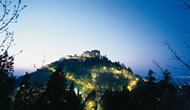
A night view of Bertinoro

Main square
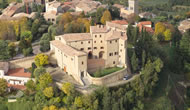
Bertinoro Castle
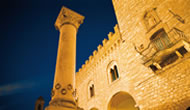
Colonna dell’ospitalità (Hopitality column)
The reality
Our reproduction of the roman Bertinoro has some basis of truth. Archaelogic findings and many roman writers talk about a Forum Druentinorum on the hills close to the Via Aemilia. The documents don’t allow us to confirm the perfect coincidence between the ancient roman fora and the town of Bertinoro.
The chance that the practice of the tertia hospitalitatis, widely practiced in IV and V centuries A.D., as the origin for the Hospitality practice is a fascinating hypotesis, but one still needing a deep historical analysis.
The origin of the current Bertinoro settlement is to be searched for around the founding of the benedictine abbey of Saint Mary of Uranus, done by three monks from Britannia. To them is due the most probable origin of the toponym Bertinoro, born from the latin Castrum Brittanorum around the first part of VIII century. Since the end of X century, the available documents cite a turris maior in castro Brittinori: it’s the first demonstration of a walled fortress on the top of the hill of Bertinoro. The document, showing the text of a placitum between the most relevant romagna nobles and the representatives of the archbishop of Ravenna is dated November 27, 995 and mentions repeatedly a defensive settlement destined to become the Bertinoro Fortress in the following centuries.
The Middle ages represent for Bertinoro a period of rich cultural flourishing: the courtly tradition, harshly missed by Dante in the XIV canto of his Purgatory, creates the hospitality tradition that at the beginning of XIII century Guido del Duca will hold as a fundamental civilization value with the building of the Rings Column.
After many different occurences, the Bertinoro Fortress becomes the town archbishop’s palace in 1584 and so stays until 1969, when the Bertinoro diocese is included in the nearby Forlì one. After a long period of neglect, the Fortress becomes the base of the University Residential Centre and the Interreligious Museum.
The fiction
The compound that in the game hosts the thermal baths was in reality the ancient Corpus Domini Monastery which became the diocese seminary in 1817 until it’s final closure in 1972. Today it is the guest room of the University Residential Centre.
The Echates Eunodiae door was actually one of the 4 medieval town doors: the only one to be lost in the first years of twentieth century. The Saints Door, still visible today has become in the game the Saturnus Door
In today’s Liberty Square we substituted the Rings Column, dating 1926 with the Jupiter Statue, while instead of the Saint Katherine of Alexandria Dome we put the Venus Temple. Finally in today’s restaurant Cà de Bè we put the Bacchus Temple.